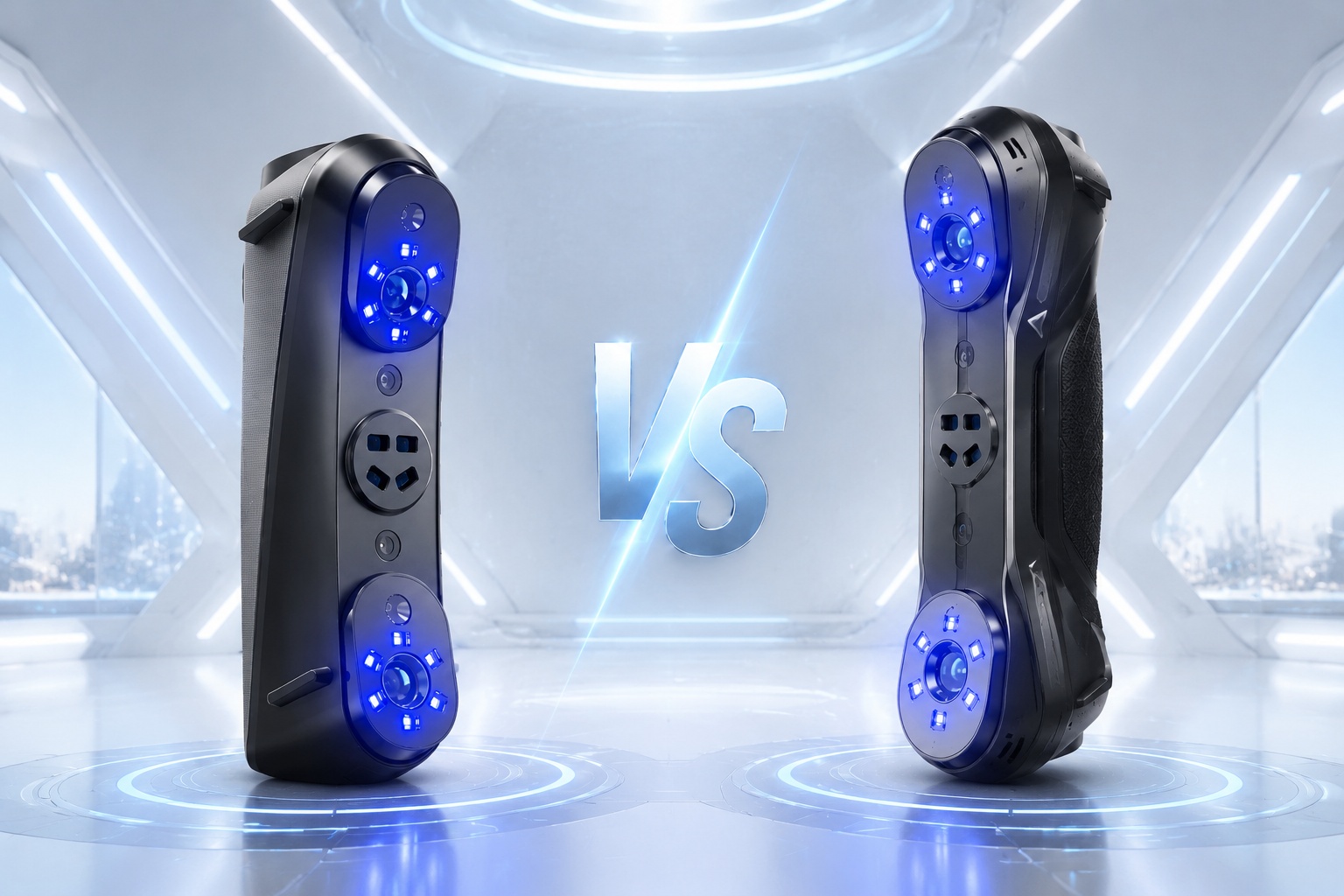




Choosing between the Creality Sermoon S1 and the CR-Scan Raptor Pro is one of the most common decisions for teams buying their first professional-grade 3D scanner. Both are blue-laser metrology scanners with up to 0.02 mm accuracy, and both handle product development, industrial inspection and reverse engineering. But they are not two versions of the same tool: the Raptor Pro is a focused high-precision laser scanning specialist, while the Sermoon S1 adds a unique single-line laser mode, higher scanning speed and a higher price tag.
This comparison walks through the real differences — laser modes, speed, deep-hole capability, large-part workflow and price — so you can match the right scanner to the parts you actually scan. Prices and specifications are from Creality's official EU store at the time of writing; check the product pages for current promotions.
At a Glance: Sermoon S1 vs Raptor Pro
| Feature | Sermoon S1 | CR-Scan Raptor Pro |
|---|---|---|
| Scanning technology | Blue laser + NIR infrared | Blue laser + NIR infrared |
| Laser lines | 34 cross + 7 parallel + 1 single line | 22 cross + 7 parallel |
| Single-line laser mode | Yes | No |
| Accuracy | Up to 0.02 mm | Up to 0.02 mm |
| Volumetric accuracy | 0.02 mm + 0.08 mm/m | 0.02 mm + 0.08 mm/m |
| Max scanning speed | Up to 90 FPS | Up to 60 FPS |
| Deep-hole / narrow-gap scanning | Excellent (single-line mode) | Challenging in very deep cavities |
| Large objects | Excellent | Excellent |
| Price (EU store) | €2,159 — check current price | €1,599 — check current price |
Price is the dimension most comparisons skip: the Raptor Pro costs about €560 less, while the Sermoon S1 charges a premium for its single-line laser and faster workflow. Whether that premium is worth it depends entirely on the geometry of your parts.
Positioning: A Specialist and a Generalist
The CR-Scan Raptor Pro is a metrology-grade handheld scanner built around one job: capturing high-quality surface data with its 22 cross blue-laser lines and NIR structured light. It is a strong fit for product digitization, quality inspection and scanning standard mechanical parts.
The Sermoon S1 starts from the same metrology foundation and then widens the toolkit: 34 cross lines for fast coverage, 7 parallel lines for detail, and a dedicated single blue-laser line that exists for one purpose — reaching geometry that multi-line scanners struggle with, such as deep holes and narrow gaps.
In short: Raptor Pro is the specialist; Sermoon S1 is the more versatile system. The rest of this article tests that claim against the specs.
Laser System: 34+7+1 vs 22+7
The biggest technical difference is the laser configuration. The Sermoon S1 combines three blue-laser modes with NIR infrared structured light, and each mode has a distinct job:
- 34 cross lines — fast coverage of large surfaces such as automotive panels and general objects;
- 7 parallel lines — higher-quality data capture on detailed, medium-sized components;
- 1 single line — direct access to deep holes, narrow gaps, recessed areas and internal structures.
The single-line mode is the S1's signature feature. Multi-line scanners project many laser lines at once, which is fast but can leave gaps where light cannot reach — the inner walls of a deep bore, for example. A single laser line can be aimed directly into that geometry, capturing data that would otherwise be missing. For anyone scanning injection molds, machined housings or parts with complex internal channels, this is not a marketing extra; it decides whether the dataset is usable for reverse engineering at all.
The Raptor Pro's 22 cross + 7 parallel configuration delivers excellent laser scanning quality for product and industrial surface work. What it does not have is a dedicated single-line mode, so extremely deep cavities and very narrow structures remain more challenging — often requiring marker placement, repositioning or supplementary scanning strategies.
Accuracy: Identical on Paper, Identical in Practice
Both scanners are specified at up to 0.02 mm accuracy with 0.02 mm + 0.08 mm/m volumetric accuracy — professional metrology territory, suitable for engineering measurement, quality inspection and CAD-ready reverse engineering.
Because the accuracy specifications are equal, the real-world difference comes from data completeness: a scanner can only be as accurate as the geometry it actually captures. A missed deep hole is not a precision problem, it is a missing-data problem — and that is why the laser system, not the accuracy figure, is the deciding factor between these two machines. (As with all manufacturer specifications, published accuracy figures reflect controlled test conditions; results in the field depend on temperature, vibration and technique.)
Speed: Sermoon S1 Is the Faster Workflow
For production and batch work, scanning speed converts directly into labor hours:
- Sermoon S1: up to 90 FPS in parallel-laser and single-line modes, up to 70 FPS in cross-line mode, with up to 1,428,000 measurements per second;
- Raptor Pro: up to 60 FPS.
The S1's speed advantage compounds on large jobs — car parts, large mechanical components, industrial equipment — where every pass and every repositioning adds time. If you scan professionally and bill by the project, the difference between 90 and 60 FPS across a full workday is significant.
Large Objects: Both Are Capable
Both scanners handle large objects such as body panels, motorcycle parts, industrial equipment and large prototypes. Both pair blue-laser precision with NIR infrared wide-field scanning, which supports faster marker-free tracking on medium to large objects.
The practical workflow on the Sermoon S1: use NIR infrared for fast marker-free coverage of large surfaces, then switch to blue laser on areas that need certified precision. The Raptor Pro supports the same blue-laser + NIR dual approach; the difference is again speed and the single-line fallback for difficult recesses.
Reverse Engineering: Which One Is Better?
Reverse engineering success depends on four things: accuracy, data completeness, access to difficult geometry, and efficiency. Both scanners deliver the first; they differ on the last two.
The Raptor Pro is a strong choice for standard mechanical parts, surface scanning and product digitization — workflows where geometry is accessible and the €560 lower price leaves budget for software or accessories.
The Sermoon S1 is the better reverse-engineering instrument when parts fight back: components with deep holes, internal structures, narrow gaps and complex edges. The single-line laser captures those features directly instead of leaving holes in the mesh that CAD work would have to patch by guesswork.
Price and Value for Money
At the time of writing, the CR-Scan Raptor Pro lists at €1,599 and the Sermoon S1 at €2,159 on the official EU store. The €560 premium for the S1 buys: the 34+7+1 laser system, up to 50% faster scanning, and the single-line mode for deep geometry.
A fair way to decide: estimate how many of your typical parts contain deep holes, slots or internal features. If that share is high, the S1's premium pays for itself in avoided re-scans and completed datasets. If your parts are mostly accessible surfaces, the Raptor Pro delivers the same accuracy for less money.
Which Scanner Should You Choose?
Choose the Sermoon S1 if you need: professional reverse engineering of complex parts, deep-hole and internal-structure scanning, the fastest scanning workflow, or one scanner that covers multiple applications. Typical users: engineering firms, manufacturers, mold makers, automotive professionals and 3D printing service bureaus.
Choose the Raptor Pro if you need: high-quality blue-laser scanning of accessible parts, industrial surface scanning and inspection, or the best metrology performance per euro. Typical users: product designers, quality-inspection teams and general industrial users.
FAQ
Do the Sermoon S1 and Raptor Pro have the same accuracy?
Yes — both are rated up to 0.02 mm with 0.02 mm + 0.08 mm/m volumetric accuracy. The difference between them is data completeness on difficult geometry and scanning speed, not the precision specification itself.
What is single-line laser scanning used for?
Deep holes, narrow gaps, recessed areas and internal structures. A single laser line can be aimed directly into geometry that multi-line projection cannot fully reach, so features like bores and slots are captured instead of left as gaps in the mesh.
Is the Sermoon S1 worth the higher price?
If you regularly scan complex or deep-featured parts and value a faster workflow, yes — the premium buys the 34+7+1 laser system and up to 90 FPS scanning. If your parts are mostly accessible surfaces, the Raptor Pro offers the same accuracy at roughly €560 less.
Can both scanners handle large objects?
Yes. Both support large-part scanning with blue-laser precision and NIR infrared structured light for marker-free tracking on medium to large objects, such as car body panels and industrial equipment.
Which scanner is better for beginners?
Both are professional tools with a learning curve. Teams that mainly need reliable surface scanning will find the Raptor Pro simpler and more affordable; teams that need to solve difficult geometry should start with the Sermoon S1's flexible laser modes.
Final Verdict
Both are genuinely professional metrology scanners, and neither is a compromise on accuracy. The Raptor Pro remains an excellent high-precision laser scanning specialist at a lower price. The Sermoon S1 is the more versatile system — a 34+7+1 laser configuration, faster scanning and a unique single-line mode that turns difficult geometry from a problem into a routine job.
Reverse-engineer complex parts → Sermoon S1 (€2,159)